
Leading University in Innovation, Research, and Education in Asia
3 August 2026
Education, Report, Internship, Student Corner
NOC Inbound
NOC Inbound Program Singapore Internship Report
Vaibhav Kumar 4th Year, Faculty of Economics Department of Economics
I’ve just wrapped up an extraordinary six months in Singapore on the NOC program and wanted to share my experience. This program is offered by the National University of Singapore (NUS), and Nagoya University is its only partner university in Japan. This is a unique way to kick off your career aspirations while experiencing Singaporean culture and student life at NUS.
As someone interested in finance, I joined the Valuations team at Qapita, a fintech specialising in cap table management! As a Valuations Intern, I conducted equity valuations for regulatory and financial reporting purposes. But friends in this program interned in fields all the way from Law and Compliance to AI and Robotics, so you can choose the niche you want to join.
Living
When I first arrived in Singapore, I thought I’d already be used to it since I’d briefly travelled through the country before. It didn’t take long to realise that living there for half a year was a completely different experience. Coming from Japan, I noticed both similarities and differences. Public transport was just as convenient, and I found myself relying on it every day to get to work and meet friends. At the same time, adapting to the work culture and everyday life, whether it was eating at hawker stalls or getting used to the pace of the city, gave me a much deeper understanding of Singapore.
I was offered accommodation at Sheares Hall, a student dormitory on the NUS campus. Being surrounded by NUS students, I was surprised by how lively the community was. As part of my accommodation, I had breakfast and dinner at the Hall every day, which made it easy to socialise and make friends. Looking back, living at Sheares Hall became one of the highlights of my time in Singapore, as it gave me the chance to experience student life alongside my internship.

Opportunities
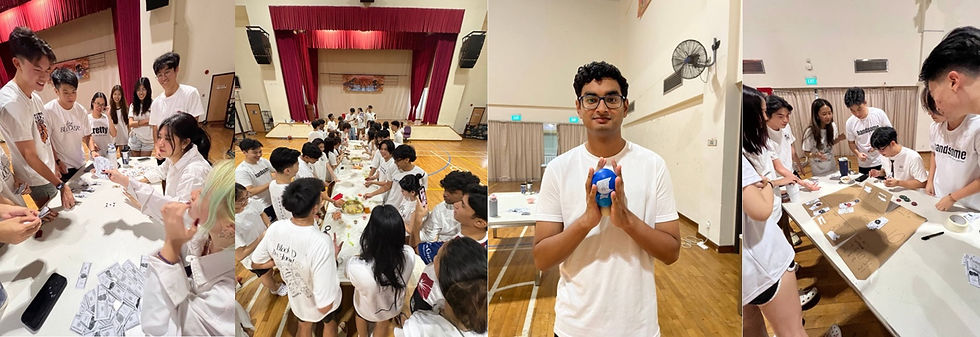
One thing I made the most of was participating in events outside work. When it came to on-campus events, there were both fun ones like the Japan Cultural Festival organised by a student group on campus, where Nagoya University was one of the main sponsors, as well as more serious ones like the career fair where I was able to get insights into job hunting.
Speaking of Nagoya University, I also got to represent them at events to promote Japan as a study destination for Singaporeans. I realised I have to work more on my public speaking skills, but it was great to share my stories with potential candidates and give them advice on the recruiting process!
Off campus is where I really took advantage of my exchange. I joined events such as a two-day Bloomberg Terminal training programme at their Singapore headquarters where a group of students were able to receive in-depth training on a vital piece of financial software used by many of the larger firms in the industry.
Beyond technical training, I also had opportunities to hear from leaders in finance such as Ray Dalio (founder of Bridgewater Associates, one of the world's largest hedge funds) at a fireside chat. It was insightful to hear his thoughts on the current world order and the stock market. He emphasised that many major events throughout history have historical precedents that we can learn from, and that economies and markets move in cycles.
As part of the NOC program, I also had the opportunity to attend many pitch contests. There seemed to be one every week! So, if you’re a founder or entrepreneur looking to launch your next venture, Singapore really is a great place to be!

NUS Experience
As part of this program, you’ll be enrolled in the Venture Creation class. This is where you’ll develop a start-up idea, go out and get real market validation, and receive feedback from Professor Virginia Cha. She has gone out there and done it herself! I still remember her story about transforming a dying gym by adding a social club aspect that helped her differentiate her from her competitors!
You’re first teamed up in groups of four to five people, and alongside seminar style classes you also go out and do real-world testing. This involved getting feedback on your startup from people on the streets, an excellent chance to develop your social skills.
One of my biggest takeaways came during a class on the concept of the beachhead market. This concept is about approaching the market as a start-up. The idea is to always target a specific niche and solve its problems first. This creates a loyal group of early adopters who can go out and spread the word about your product. I realised I had made this mistake in a previous venture where my plan centred around trying to capture as large of a market as possible. Without a clearly defined niche, it also becomes much harder to execute a focused marketing strategy.

Working
It’s funny that this section ended up near the end, because your internship will probably be the biggest part of your experience. After all, it’s where you’ll spend 40 hours a week.
As I joined the Valuations team at Qapita, most of my work centred around Excel. I conducted private company valuations for financial reporting purposes. The best thing about my internship was the steep learning curve. Within two days of joining, I asked my boss if I could dive straight into a live project and learn on the job! Thankfully, she was more than happy to let me and I was able to pick up the required knowledge and skills at a much faster rate and was also able to contribute to real deliverables which gave me a sense of pride.
The most valuable lesson I learned wasn’t how to build financial models or perform valuations. It was learning that making mistakes is part of the job and often the fastest way to improve. Rather than staying within my comfort zone, I found it far more rewarding to volunteer for projects that stretched my abilities. Naturally, that meant making more mistakes, some of them with real consequences, but each one became a learning opportunity. By the end of my internship, I was able to contribute to complex projects with far greater confidence. My proudest moment was leading over ten valuation engagements end-to-end, from gathering data and building the financial models to writing the final valuation reports. None of this would have been possible without a supportive team that was willing to trust an intern with real responsibility while also taking the time to review my work and provide constructive feedback.


Final thoughts
The best thing about this internship is that you can do whatever you’d like! If you’re more interested in learning about the job market, attend the weekly events in the CBD (Central Business District) area or at the NUS campus. More interested in socialising? Go out with your fellow interns, classmates or dormmates. If you’re interested in travelling, take a trip every month to a new destination, Singapore is conveniently located in Southeast Asia. Whatever the case, if you have the chance to take this internship, I highly recommend that you do so, it’s great fun and helps you grow both personally and professionally!
If you feel nervous about moving to a foreign land, please rest assured that you’re supported by Nagoya University and its Singapore office where both Imaizumi-sensei and Eugena-san will take care of you! Feel free to connect with me on LinkedIn if you have any questions about the program, I’d be happy to help!
