
Leading University in Innovation, Research, and Education in Asia
![📢 [Event] The 1st NUS–NU Workshop at Singapore: "Media in Motion: Bridging Digital and Critical Humanities" (Dec 19,2025)](https://static.wixstatic.com/media/27d38b_a7b110acd53e45b2bc27875ea6cacb87~mv2.jpg/v1/fill/w_980,h_337,al_c,q_80,usm_0.66_1.00_0.01,enc_avif,quality_auto/Image-empty-state.jpg)
3 December 2025
Education
📢 [Event] The 1st NUS–NU Workshop at Singapore: "Media in Motion: Bridging Digital and Critical Humanities" (Dec 19,2025)
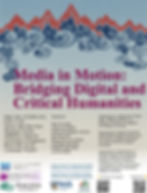
The 1st NUS–NU Workshop at Singapore
Media in Motion: Bridging Digital and Critical Humanities
Date:
19 (Fri) December 2025
Venue:
Wan Boo Sow Research Centre (WBSRC), National University of Singapore, Block AS8, 05-49
Language:
English
Organized by:
Collaborative Project Team, “Media in Motion: Bridging Digital and Critical Humanities,” by National University of Singapore and Nagoya University
Sponsored by:
Nagoya University Global Multi-Campus Program; and the Center for Digital Humanities and Social Sciences, Nagoya University
Supported by:
Departments of Chinese Studies and Japanese Studies, National University of Singapore; and the Center for Transregional Culture and Society, Graduate School of Humanities, Nagoya University
. Registration:
This workshop marks the inaugural step in our collaborative research initiative, Media in Motion: Bridging Digital and Critical Humanities. It brings together team members to share their previous research and current scholarly interests, fostering dialogue on how these individual pursuits can be developed into a cohesive, transdisciplinary project. Our overarching research agenda centers on historical and contemporary contexts in East and Southeast Asia, exploring how textual, visual, and aural media have mediated and accelerated the circulation of people, goods, and information. We aim to critically examine the dual impact of these media driven dynamics—how they have contributed to societal advancement while also intensifying challenges such as social inequality and environmental degradation. A distinctive feature of our approach is the integration of two complementary methodologies: the innovative tools and techniques of digital humanities, and the deeply contextual insights of critical humanities. This workshop will serve as a platform for presenting individual research findings, facilitating intellectual exchange, and collaboratively shaping the trajectory of our unified research agenda. In-person engagement will play a vital role in deepening mutual understanding among team members and in synthesizing diverse disciplinary perspectives, thereby laying a robust foundation for the next phase of our project.
. WORKSHOP ETHOS
This workshop diverges from the format of conventional academic conferences. Rather than adhering to established disciplinary boundaries and traditional categories, it fosters dynamic dialogue and the free exchange of ideas and visions, with the aim of inspiring innovative collaborative research.
. SCHEDULE
9:30-9:45 | Opening remarks |
9:45-10:15 | Zhixi Yin Imagining Asian Civilizations in Japanese and Chinese Fiction of the 1960s–1970s |
10:15-10:45 | Lanjun Xu Inter-Asia in Motion: Rethinking Chinese Popular Cultures in Cold War Southeast Asia |
Coffee/tea | |
11:00-11:30 | Cindy Anh Nguyen Computational Thinking: Task Abstraction, Counting, and Interpretation in Humanities Research |
11:30-12:00 | Ran Ma From Asia, Archipelagically: Rethinking Film Festival Studies |
Lunch | |
13:30-14:00 | Beng Choo Lim Digital Humanities and Southeast Asia Japanese Studies |
14:00-14:30 | Yoshitaka Hibi Digital Horizons and Human Costs: Rethinking Digital Technologies in the Humanities |
Coffee/tea | |
14:45-15:15 | Hideaki Fujiki Mediatizing Ecology and Tourism, Mediating Locality and Planetary |
15:15-15:45 | Lin Du Digital Historical Forensics: A Computational Approach to Wartime Media Cultures during WWII |
Coffee/tea | |
16:00-17:15 | Roundtable |
17:15-17:30 | Ending remarks and conversation |
. PRESENTERS
Lin DU
Lin DU is currently an Assistant Professor jointly appointed in the Departments of Chinese Studies and Japanese Studies at the National University of Singapore, after completing her postdoctoral fellowship in the same departments. She completed her PhD at the Department of Asian Languages and Cultures at UCLA, where her dissertation, "Chinese Photojournalism 1937–1952: Materiality and the Institutionalization of Culture via a Computer Vision Approach," utilized advanced computer vision techniques to explore wartime visual media culture. Lin holds an MA from the Regional Studies East Asia Program at Harvard University and a BA in Chinese Language and Literature from Peking University. Her pioneering work in machine learning has been published in the ACM Journal on Computing and Cultural Heritage (JOCCH), and her contributions to humanities research are published in the Journal of Chinese Cinemas and forthcoming in Asia Pacific Perspectives.
Hideaki FUJIKI
Hideaki FUJIKI is professor in screen studies and currently the director of the Center for Transregional Culture and Society at the Graduate School of Humanities, Nagoya University. His books include Making Audiences: A Social History of Japanese Cinema and Media (Oxford University Press, 2022); Making Personas: Transnational Film Stardom in Modern Japan (Harvard University Asia Center, 2013); and The Japanese Cinema Book (co-edited with Alastair Phillips, BFI, 2020). His recent essays include “Memory Boom and Media Ecology after the 3/11 Fukushima Disaster” in Brill’s Handbook of Memory Studies in East Asia (Brill, forthcoming); “Diverging Imaginations of Planetary Change: The Media Franchise of Japan Sinks” in Eco Disasters in Japanese Cinema (Association for Asian Studies, 2024); “Contesting Screens of Energy: Gaia, the Commons and Infrastructure,” Screen (2025); “Centring Disabilities in the Ecological Imagination of the 3/11 Disaster through Documentaries,” Studies in Documentary (2025); and “Mediating Cinema and the Planet through Science: The Science/Fiction Boundary Revisited with Japan Sinks,” Journal of Japanese and Korean Cinema (forthcoming); and “Orchestrating Spectacles: Cinema of Project from Tokyo Olympics ‘64 to Expo ’70” in ReFocus: The Films of Kon Ichikawa (Edinburgh University Press, forthcoming). He is currently completing the monograph titled Ecology from Fukushima: Locality and Planetary with Screen Media, which discusses cinema and media in relation to a range of ecological issues, such as energy, waste, animals, disabilities, memories, radiation, and the Anthropocene.
Yoshitaka HIBI
Yoshitaka HIBI is a professor of modern Japanese literature, print culture, and digital humanities at the Graduate School of Humanities, Nagoya University. He serves as the editor-in-chief of the journal Modern Japanese Literary Studies. He is the author of the Japanese language books, A Literary History of Self-Representation: The Emergence of Novels That Write the Self (Jikohyōshō no Bungakushi: Jibun wo Kaku Shōsetsu no Tōjō); Japanese America: Immigrant Literature, Publishing Culture, and Internment Camps (Japanīzu Amerika: Imin-Bungaku, Shuppan -Bunka, Shūyōjo), and Bookstores of Empire: The Knowledge Networks Woven by Books in Modern Japan (Teikoku no Shoten: Shomotsu ga anda Kindai Nihon no Chi no Nettowāku). His research includes numerous articles on the I-novel, privacy and literary writing, as well as computational approaches to modern Japanese literary texts.
Beng Choo LIM
Beng Choo LIM is Associate Professor and Head of Japanese Studies Department at the National University of Singapore. Her early trainings were in traditional Japanese theatre and literature, although her research interests include different fields of Japanese culture, both traditional and contemporary. She is the author of Another Stage – Kanze Nobumitsu and the Late Muromachi Noh Theatre (Cornell East Asia series, 2012) and several articles on Japanese theatre performance. She has planned and coordinated the production of video recordings of traditional Japanese performance including noh, kyogen and nihon buyo. She is currently working on two noh-related projects: the relationship between traditional Japanese theatre and digital technologies; karamono (Chinese-themed) noh plays in history. Her latest project is on the state of Japanese Studies in Southeast Asia.
MA Ran
MA Ran is an Associate Professor in the Japan-in-Asia Cultural Studies (JACS) and Screen Studies programs at Nagoya University. Her research focuses on Inter-Asia film and screen cultures and film festival studies, and she has published articles in Verge: Studies in Global Asias, Journal of Chinese Cinemas, and Journal of Japanese and Korean Cinema, as well as book chapters in Chinese Film Festivals: Sites of Translation, The Japanese Cinema Book, and The Routledge Companion to Asian Cinemas. While her scholarship primarily engages with Sinophone world cinema, Ma also examines the political aesthetics of Okinawa-related image cultures, situating them within broader debates on archipelagic media and ecologies across diverse film and art projects from East Asia and beyond. Another strand of her research investigates the history and politics of transnational media between China and Japan since the late Cold War, with particular attention to media technology, infrastructure, and decolonization. She is the author of Independent Filmmaking across Borders in Contemporary Asia (Amsterdam University Press, 2019).
Cindy Anh NGUYEN
Cindy Anh NGUYEN is assistant professor in Information Studies, Digital Humanities, and Asian Languages & Culture at University of California, Los Angeles (UCLA). Her multifaceted digital humanities work bridges computation and critical data analysis as a commitment to global south cultural heritage and community engaged research. Her transdisciplinary research examines the historical and socio-technical production of knowledge in Southeast Asia through libraries, encyclopedia, visual media, and language through feminist, decolonial, and critical approaches. Her book, Bibliotactics: Libraries and the Colonial Public in Vietnam (University of California Press, 2026) uncovers how libraries functioned as instruments of colonial dominance and an experimental space of public critique. Her work has appeared in Journal of Vietnamese Studies, Verge: Studies in Global Asia, Journal of Interactive Technology and Pedagogy, the Vietnamese American Refugee Experience Model Curriculum, and numerous edited volumes on history and digital humanities. Nguyen is also a public scholar, educator, and community artist exploring themes of memory and migration.
Lanjun XU
Lanjun XU is Associate Professor of Chinese Studies at the National University of Singapore. Her research focuses on the cultural history of children in modern and contemporary China, the cultural Cold War in Asia and Chinese cinema, and the transregional circulation of literature, media, and print between postwar China and Southeast Asia. She is currently working on a monograph examining cross-regional cultural interaction networks in performing arts, tabloids, cinema, and publishing across China and Southeast Asia from the 1940s to the 1970s. She also leads a Singapore Ministry of Education Tier-2 research project, Popular Chinese Cultures in Postwar Singapore and Malaya (www.chinesepopularcultures.sg), which develops a digital archive and scholarly platform for the study of Chinese popular culture in the region. Her publications include Children and War: Nation, Education, and Popular Culture (Peking University Press, 2015) and Chineseness and the Cold War: Contested Cultures and Diaspora in Southeast Asia and Hong Kong (co-edited with Jeremy Taylor, Routledge, 2021), among others. Her essays have appeared in Twentieth-Century China, Asian Theatre Journal, Modern Chinese Literature and Culture, and Literary Review.
YIN Zhixi
YIN Zhixi is an Associate Professor in the Japanese Cultures Studies Program at the Graduate School of Humanities, Nagoya University. Her primary area of expertise is contemporary Japanese literature, with a particular focus on detective fiction. Her research explores how literary narratives, especially detective fiction written in post-war Japan, reflected and shaped readers' perceptions of society and culture, while examining the interrelations and differences between Chinese and Japanese popular culture during the Cold War. Yin is the author of Booms in Social Mysteries: Postwar Japanese and Chinese Society in the Narratives of the "Incidents" (Shakaiha Misuteri Būmu: Nicchū Taishūka Shakai to “Jiken no Monogatari”) (Tokyo: Kachōsha, February 2023), which examines the rise of socially engaged detective fictions and their impact on popular culture both in Japan and China during the Cold War. Her current research focuses on the representations of Asian civilization in Chinese and Japanese novels from the 1960s to 1970s, particularly historical mystery narratives involving Zoroastrianism—an ancient, monotheistic religion from Persia. Her presentation aims to bridge Chinese and Japanese literary studies, deepening our understanding of how fiction mediates cultural, historical, and social imaginaries across East Asia.
